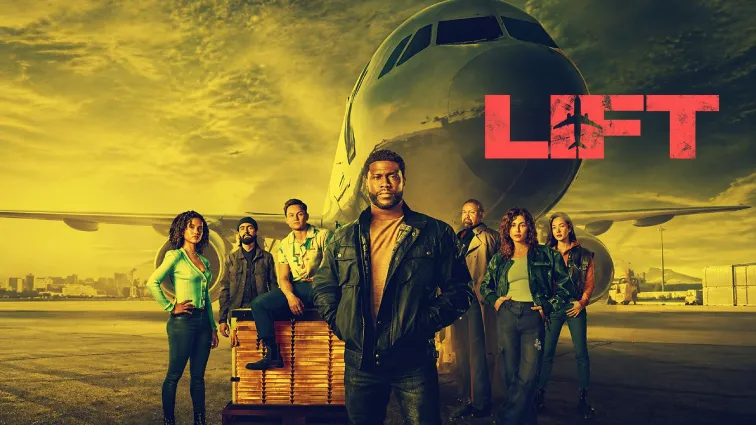
Netflix has a habit of packaging familiar ideas in shiny new wrapping and calling it a blockbuster. From international spy thrillers to car chase extravaganzas, the streaming giant knows how to produce content that looks expensive and feels exciting in the trailer. Lift, the 2024 action-heist film starring Kevin Hart, is the latest entry in this tradition. It arrives with real star power, a proven director, and a genuinely fun premise. Yet despite all that, it never quite manages to soar as high as it should.
What Is Lift Actually About?
At its core, Lift is a classic heist movie dressed up in modern clothing. Kevin Hart plays Cyrus Whitaker, a charming, high-functioning career criminal who leads a tight-knit crew of specialists. They steal art from people who, in their view, do not deserve it. When Interpol catches up with them, agent Abby Gladwell (Gugu Mbatha-Raw), who also happens to be Cyrus’s former flame, presents them with an unusual deal.
The mission: steal half a billion dollars’ worth of gold bullion from a commercial passenger flight traveling from London to Zurich, while the plane is still in the air. The gold is intended as payment for a group of hackers hired by a wealthy villain named Lars Jorgenson (Jean Reno) to cause widespread destruction by disrupting power grids and triggering floods. In exchange for pulling off this impossible task, Cyrus and his crew are offered full immunity.
It sounds wild, and it is. But the film leans into absurdity with enough confidence that you are mostly willing to go along for the ride.
The Crew and the Concept
One of the more enjoyable elements of any heist film is watching the team come together. Lift follows the formula faithfully. There is Camila (Ursula Corbero), the unflappable pilot. Magnus (Billy Magnussen) is the hyperactive safecracker, and he is easily one of the most entertaining characters in the film. Mi-Sun (Yun Jee Kim) handles the hacking, Luc (Viveik Kalra) covers engineering and gadgets, and Denton (Vincent D’Onofrio) is the master of disguise.
Each character gets a brief title card explaining their specialty, and that is largely all you get. The script by Daniel Kunka does not invest much time in developing these people beyond their job descriptions. They are defined by what they do rather than who they are. You could honestly pull one or two of them off the plane mid-heist and the dynamic would barely shift.
It is also worth mentioning Jacob Batalon, who pops up in a small supporting role and gets a few decent moments, and David Proud, who plays a character that brings some genuine British humor to the proceedings and represents a kind of casual, no-fuss disabled representation that more films could learn from. These smaller roles add texture that the main crew sometimes lacks.
Sam Worthington, meanwhile, plays Abby’s Interpol boss and is asked to be generically unlikable. He manages it efficiently but there is nothing here that suggests the role needed to be his specifically.
Billy Magnussen Steals the Show
If one cast member manages to break free from the generic mold, it is Billy Magnussen. His portrayal of Magnus is gleefully unhinged in the best way possible. He brings a physical, comedic energy to the role that stands out against the otherwise fairly straight-faced tone of the film. There is a running bit involving a piece of gadgetry disguised in a rather undignified way that gets the biggest laugh in the movie, and Magnussen sells it perfectly without winking too hard at the camera.
Several reviewers noted that he seemed to be performing in a slightly different, more fun version of the movie, and that is an accurate observation. Every scene he is in has a spark that the rest of the film occasionally lacks. One critic compared his energy to Brad Pitt in Burn After Reading, which is a stretch, but you understand what they were going for.
Kevin Hart in a New Role
Perhaps the most discussed aspect of Lift is Kevin Hart stepping outside his usual comedic comfort zone. Hart has built his career on being the fast-talking, relatable everyman. Here, he plays a suave, calm, and calculated leader. Cyrus is cool under pressure, romantically confident, and not played for laughs.
Does it work? Partly.
Hart clearly puts in the effort, and there are stretches of the film where the dramatic angle holds up reasonably well. His chemistry with Gugu Mbatha-Raw is serviceable if not electric. There is a scene on the plane where the two of them are essentially running a con side by side in first class, speaking into earpieces while keeping their composure around the villain’s associates, and it works because Hart plays it straight and trusts the situation to carry the comedy.
However, his natural comedic instincts are hard to fully suppress. There are moments where his delivery of serious lines carries an awkward quality, as though he is holding himself back from a punchline that never arrives. It is not a bad performance, but it does feel like a slightly uncomfortable fit. The film is better when it stops trying to make Cyrus a brooding romantic lead and just lets Hart be a smart, charming guy who is good at his job.
F. Gary Gray Behind the Camera
Director F. Gary Gray is no stranger to this kind of material. He directed the 2003 remake of The Italian Job, the Fast and Furious sequel Fate of the Furious, and the critically acclaimed Straight Outta Compton. He understands the mechanics of a heist film and knows how to put together a compelling action sequence.
His experience shows in Lift. The opening sequence in Venice, featuring a speedboat chase through the canals, is genuinely enjoyable and well-staged. Gray clearly chose the Venice setting specifically for that chase, and it pays off. The in-flight sequences during the third act, with hand-to-hand combat mid-turbulence and the plane actually rolling over and sending characters tumbling everywhere, are effective enough to raise the pulse and justify the setup.
Where he loses ground is in the connective tissue between those moments. The banter scenes in the warehouse and the high-rise safe house feel flat, with bright, even lighting that gives everything a slightly televisual quality. Gray has a few nifty shots scattered throughout, but there is also an overabundance of lens flare that adds flash without adding style.
Style Without Substance
Where Lift runs into trouble is in everything surrounding the action. The production values are clearly high, as is typical for a major Netflix release. But the visual polish sometimes compensates for the thinness of the story rather than enhancing it. The film looks great without always giving you a compelling reason to care about what is happening in the frame.
The villain is a particular weak point. Jean Reno is a capable actor, but Jorgenson is written as a generic antagonist. His motivation, something about shorting stocks and needing the hackers paid before chaos breaks out, is mumbled through in a few scenes without ever landing. He barely registers as a threat. A heist movie lives or dies not just on the quality of the plan but on the stakes created by the opposition, and Lift never makes Jorgenson feel genuinely dangerous. He could be replaced by a scarecrow in a nice suit and the film would not change much.
The NFT Problem
The opening heist is built around an NFT. The film even acknowledges within its own dialogue that NFTs were a passing trend, which raises an obvious question about why the entire opening sequence was built around one in the first place. It creates an awkward tone from the very first scene, one that the film has to work hard to recover from.
The intention was probably to make Cyrus and his crew feel current and culturally savvy. What it actually does is date the film before it has even introduced its main plot. Watching a gang of sophisticated international thieves chase the price of a digital jpeg is not the thrilling opener anyone was hoping for.
What Works and What Does Not
The film’s strongest moments come when it commits fully to the fun of its own premise. The heist sequences, once they properly get going, are entertaining in the way a good theme park ride is entertaining. You do not ask too many questions and you enjoy the motion.
The weaker elements stem largely from the screenplay. The romantic subplot between Cyrus and Abby takes up a significant amount of screen time without building to anything particularly meaningful. There is a scene midway through the in-flight heist where Abby spends several minutes creating a distraction in an airplane bathroom, and while it gets a laugh, it also highlights how the script sometimes leans on broad comedy to paper over the gaps in its logic.
How It Compares to Other Heist Films
Lift invites comparison to the Ocean’s series, The Italian Job, and the more recent Netflix heist Red Notice. It fares better than Red Notice in most respects, largely because Gray brings a level of directorial control that raises the material. It is more watchable and coherent than most of its peers in the Netflix blockbuster catalogue.
But it does not approach the genuine wit and character depth of the best heist films. The Ocean’s movies worked because every character, no matter how small their role, had a distinct personality and a comic rhythm. You could not swap one out and call it the same movie. In Lift, most of the crew are interchangeable. They have titles, not personalities.
If you want a recent comparison that gets this format right, Bullet Train understood that a heist on a fast-moving vehicle only works if the people trapped inside it are genuinely interesting. Lift did not learn that lesson.
Is Lift Worth Watching?
That depends entirely on what you are looking for. If you want a breezy, well-produced action film that passes 104 minutes pleasantly without demanding too much, Lift delivers that. It has enough set pieces, enough charm in moments, and enough of a cast to qualify as decent entertainment on a Friday night when you do not want to think too hard.
If you are hoping for something that lingers after the credits roll, with memorable characters, sharp writing, or genuine emotional stakes, you will come away feeling that Lift could have been so much more.
Final Thoughts
Lift is the cinematic equivalent of a well-made meal from a chain restaurant. Competent, appealing, and it does what it promises. But it lacks the personal touch and distinctive flavor that would make it truly memorable. Kevin Hart shows genuine willingness to stretch as a performer. F. Gary Gray handles the action with professionalism. The ensemble cast does its best with thin material. Billy Magnussen alone is worth a few scenes of your time.
The film had all the ingredients for a great time: a charismatic lead, an experienced director, a globe-trotting premise, and a cast full of talent. What it needed was a screenplay willing to take a few more risks and characters worth caring about beyond their function in the plot. Fans of the genre will find enough here to enjoy. Everyone else might find themselves reaching for something else when it is over, not out of disappointment exactly, but simply because Lift did not give them much to hold onto.