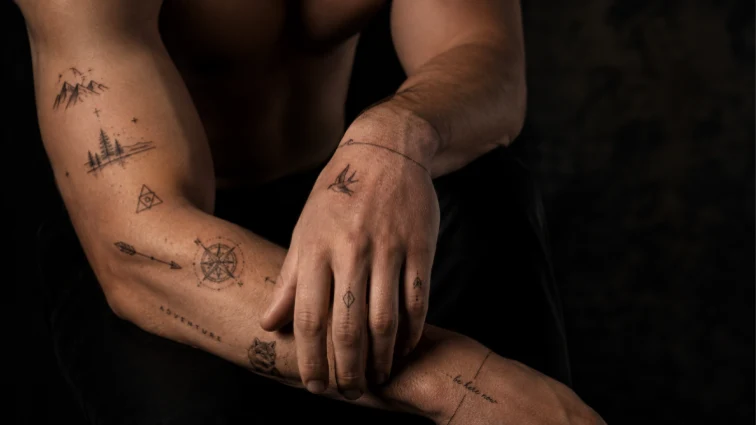
Here is the thing most tattoo listicles will not say out loud: a bad small tattoo is worse than no tattoo at all. Because unlike a large piece where imperfections get lost in the composition, a small tattoo has nowhere to hide. Every shaky line, every blown-out dot, every slightly off proportion is on permanent display.
That is actually what makes small tattoos for men so exciting in 2026.
The rise of fine line tattooing, single needle techniques, and a new generation of artists trained specifically in micro and minimalist work means that small tattoos today look better than they ever have. Men are choosing them not as a compromise, but as a deliberate, confident statement.
Even celebrities like Ed Sheeran, whose arms are covered in small, personal pieces, have helped normalize the idea that intentional small tattoos can be just as compelling as large-scale work. They are walking into studios with references, asking for precision work, and treating a one-inch design with the same seriousness they would give a full sleeve.
This post covers 20 of the most meaningful, well-designed, and currently trending small tattoo ideas for men. For each one, you will get the real symbolism, honest placement advice, style recommendations, and what to expect cost-wise. No filler. No vague “carries deep meaning” language. Just the information you actually need to make a great decision.
Typical cost range for small tattoos in 2026: Most quality studios charge a shop minimum of $80 to $150 regardless of size. Fine line small tattoos generally run $100 to $300 depending on complexity and artist experience. If someone quotes you $40 for fine line work, walk away.
The 20 Best Small Tattoos for Men in 2026
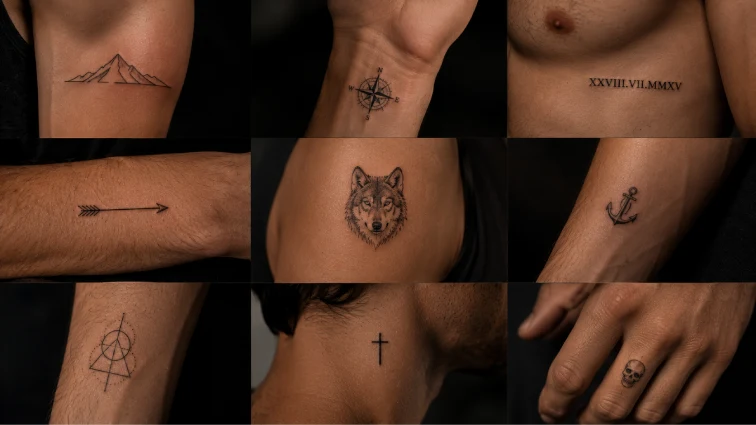
Small tattoos for men in 2026 are a deliberate statement, not a compromise. From single line mountains to meaningful coordinates, these 20 designs combine clean artistry with personal symbolism. Each one is worth getting for the right reasons, chosen with intention, executed with precision, and built to last a decade or more.
1. Single Line Mountain
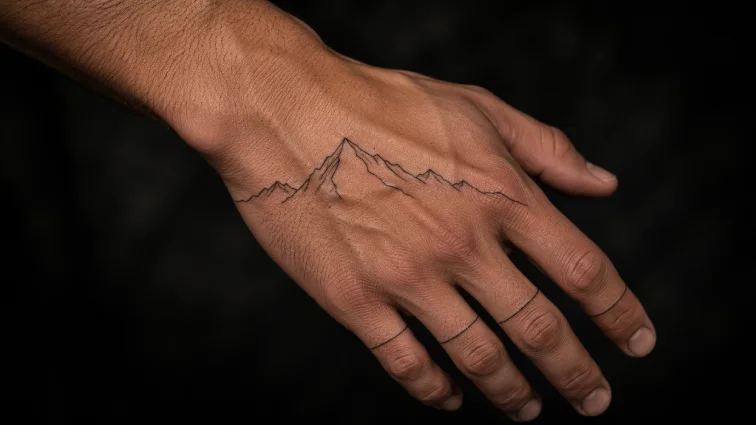
What it is: One unbroken, continuous line that traces a mountain silhouette, no fill, no shading, just the elegance of a single stroke.
Why men are getting it: This design is a quiet flex on the artist who executes it. Because there is only one line, any hesitation or wobble shows immediately. A clean single line mountain signals that you cared enough to find someone exceptional.
Beyond technique, the symbolism is genuinely compelling. Mountains represent obstacles that are worth the climb, not obstacles that stop you. It is the visual shorthand for “I do hard things and I am fine with that.”
Best placement: Inner wrist, forearm, or collarbone. The collarbone placement has become particularly popular in 2026 because it follows the natural curve of the bone, making the mountain feel like it is part of your anatomy.
Style to ask for: Single needle or fine line. Avoid artists who typically do bold or traditional work, this requires a very controlled, precise hand.
Estimated cost: $100 to $180
2. Small Compass
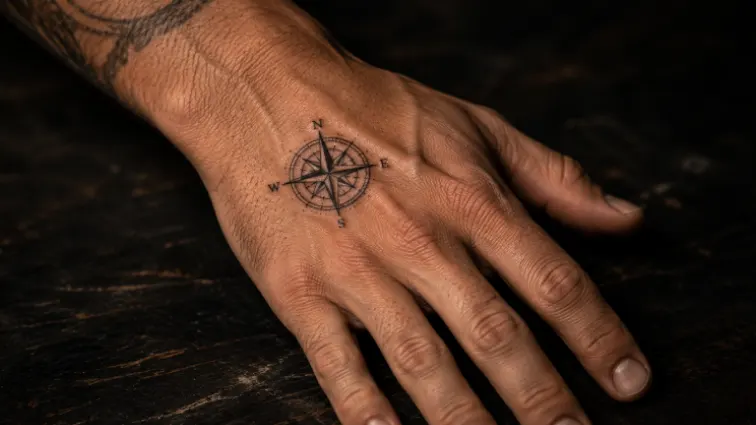
What it is: A compact compass design, ranging from an ultra-minimal four-point star to a fully detailed nautical compass rose.
Why men are getting it: The compass has outlasted dozens of tattoo trends because its meaning never gets old. Direction. Purpose. The refusal to stay lost. In a decade where men are being asked hard questions about who they are and where they are going, a compass feels earned rather than decorative.
Best placement: Inner wrist for maximum daily visibility, or behind the ear for something more private. If you go behind the ear, size matters enormously, keep it under an inch or it will look crowded.
Style to ask for: Geometric compass designs are dominating in 2026. Clean, sharp angles and micro-thin lines give a modern, architectural feel that photographs brilliantly. If you want something more sentimental, a traditional compass rose with careful fine line shading is timeless.
Honest note: Compass tattoos are popular, which means they are also commonly done poorly. Spend extra time finding an artist whose portfolio shows clean symmetry and consistent line weight.
Estimated cost: $120 to $250 depending on detail level
3. Roman Numerals
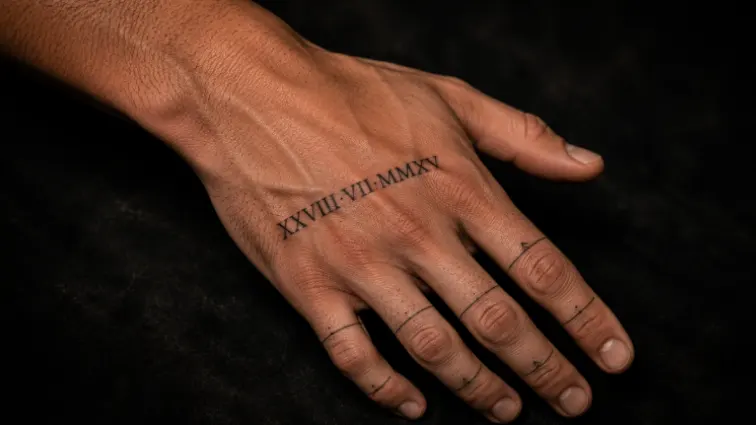
What it is: A meaningful date or number rendered in Roman numerals, I, V, X, L, C, D, M.
Why men are getting it: Roman numerals are the most private public tattoo that exists. They carry your most important date without announcing it to everyone. The story is yours. You choose who you tell.
Common dates men choose: a child’s birth date, the day they got sober, the date of a loss, a wedding anniversary, or a day that simply changed everything. There is no wrong answer as long as it genuinely means something to you.
Best placement: Inner forearm, ribcage, or along the collarbone. The ribcage works well for dates connected to grief or something deeply personal. The forearm works for something you want to see every day.
Style to ask for: Clean serif font, no decorative flourishes unless you are specifically going for a vintage look. Avoid overly condensed lettering that will blur as the tattoo ages. Ask your artist to show you how the numerals will look at five and ten years of healing.
Critical tip: Triple-check your math before the appointment. Converting dates to Roman numerals is surprisingly easy to get wrong, and it is a permanent mistake.
Estimated cost: $80 to $150
4. Minimalist Arrow
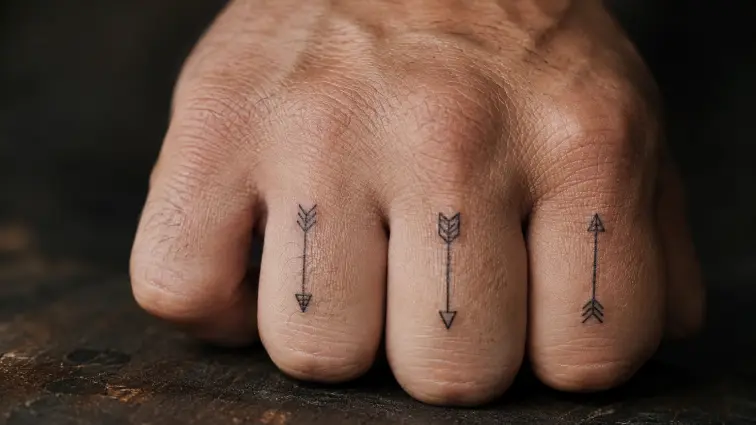
What it is: A simple arrow, reduced to its most essential form, a straight line, an arrowhead, and sometimes tail feathering.
Why men are getting it: The arrow is one of the few tattoo symbols that changes meaning based on its position, and that is what makes it versatile rather than generic. A single arrow pointed forward means forward motion and intention. An arrow pulled back on a bow represents gathering strength before a launch. Two crossed arrows, borrowed from Native American traditions, represent friendship, though it is worth understanding the cultural origins before choosing this variation.
Best placement: Forearm running lengthwise from wrist to elbow, giving the arrow a natural direction. Also popular on the back of the hand or the index finger, though finger tattoos fade significantly faster.
Style to ask for: Minimalist with one deliberate detail, a geometric arrowhead, a tiny rune along the shaft, or a subtle pattern in the tail. Purely plain arrows can look unfinished. One intentional extra element elevates the design from simple to considered.
Estimated cost: $80 to $160
5. Wolf Head
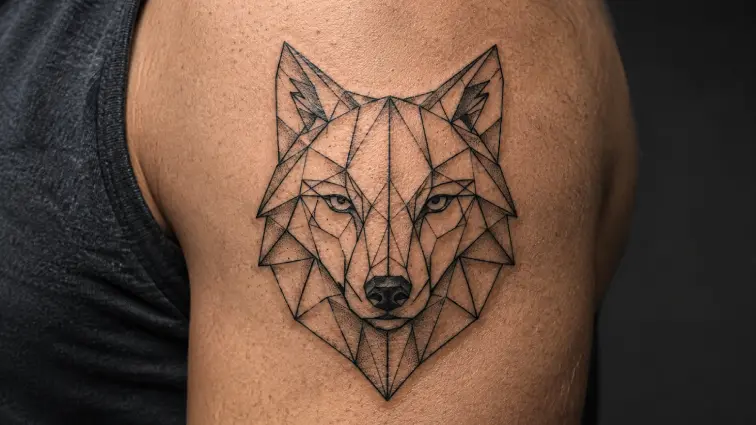
What it is: A wolf’s face rendered in fine line, geometric, or stipple shading style, typically facing forward or slightly angled.
Why men are getting it: The wolf is not just an edgy tattoo choice, it is one of the most psychologically loaded animal symbols in human history. Wolves are simultaneously fierce and deeply loyal. They are individualistic but live by a code of pack and family. If you see yourself that way, protective, loyal to a small circle, independent by nature, the wolf earns its place on your skin.
Best placement: Upper forearm, outer upper arm, or calf. These placements give the artist enough surface area to render the face with real detail, even at a small scale.
Style to ask for: Geometric wolf designs built from triangles and clean lines are the strongest trend in 2026. They age beautifully because the geometric lines hold better than photorealistic shading over time. Fine line stipple shading is a close second and can look stunning.
Estimated cost: $150 to $280
6. Anchor
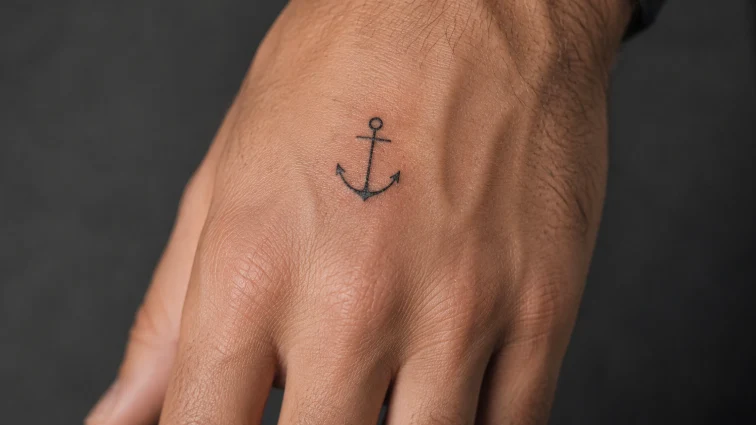
What it is: A classic maritime anchor, now reimagined in clean, minimal fine line work rather than the thick bold outlines of traditional sailor tattoos.
Why men are getting it: The anchor’s meaning has evolved well past its nautical origins. Today it represents the person, place, or value that keeps you grounded when life gets rough. Men get anchors to honor a parent who held the family together, a partner who kept them steady, or simply as a reminder of their own internal foundation.
Best placement: Inner wrist, ankle, or behind the ear. All three placements allow for a small design that reads clearly. The wrist version is the most visible day-to-day, which makes it ideal if you want the reminder where you can see it.
Style to ask for: A modern fine line anchor with clean proportions. Avoid the thick outlines of old-school traditional tattooing unless that aesthetic is intentional. A rope detail wrapped around the anchor adds dimension without requiring much additional space.
Estimated cost: $100 to $180
7. Fine Line Geometric Shapes
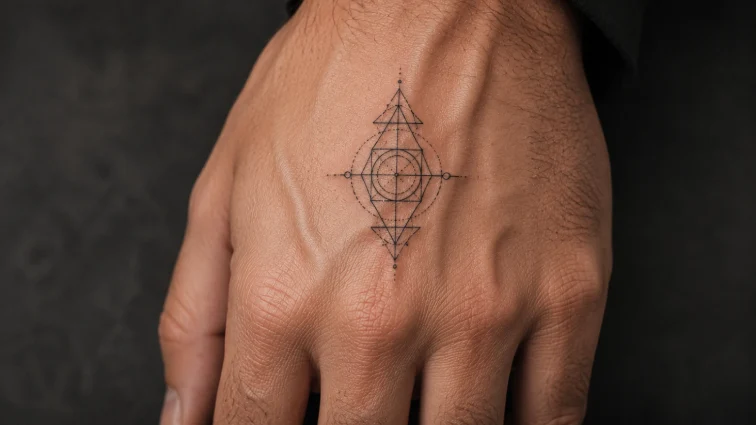
What it is: Sacred geometry, clean polygons, or abstract geometric compositions, triangles, hexagons, dodecahedrons, Metatron’s Cube, the Flower of Life, and more.
Why men are getting it: Geometric tattoos appeal to men who think in systems. There is something satisfying about a symbol that represents an idea through mathematical precision rather than narrative image. The triangle represents stability and the trinity of mind, body, and spirit. The hexagon appears constantly in nature, from honeycombs to snowflakes, and represents harmony within structure. The Fibonacci spiral connects to growth and natural order.
Best placement: Back of the hand, upper chest, or the back of the neck. Geometric shapes benefit from flat, uncrowded placement where the lines can breathe.
Style to ask for: Ultra-fine lines with precise angles. Even a one-degree error in a geometric tattoo is noticeable. This is the style where artist selection matters most. Only choose an artist with a substantial portfolio of healed geometric work.
Estimated cost: $120 to $250
8. Small Cross
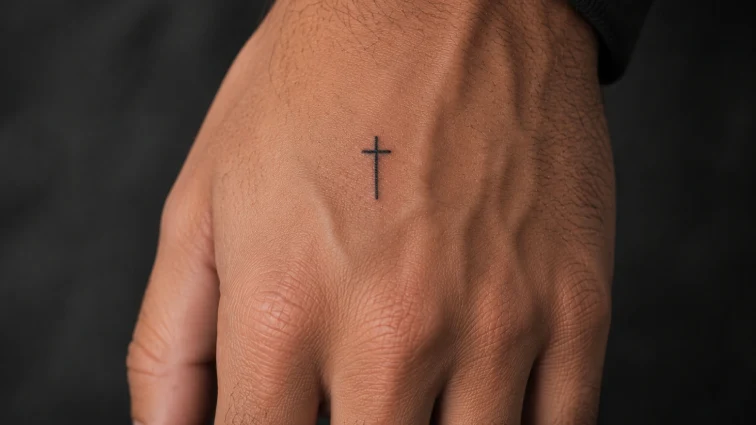
What it is: A cross in any of its many forms, the simple Latin cross, the Orthodox cross, an outlined cross, or a three-dimensional shadow cross.
Why men are getting it: The cross is one of the oldest human symbols and carries meaning that extends far beyond organized religion. Faith. Sacrifice. The intersection of two paths. For men with deep religious roots, it is an unambiguous declaration. For men who are more spiritual than religious, it represents a willingness to carry something, to bear weight without breaking.
Best placement: Inner wrist for daily visibility, upper chest near the heart for something more private and personal.
Style to ask for: A clean two-dimensional cross in consistent fine line weight is the most timeless option. A three-dimensional cross with subtle shading adds depth without requiring extra space. Avoid decorative additions like wings or crowns unless they carry specific personal meaning, they often make the design look cluttered at a small scale.
Estimated cost: $80 to $140
9. Micro Skull
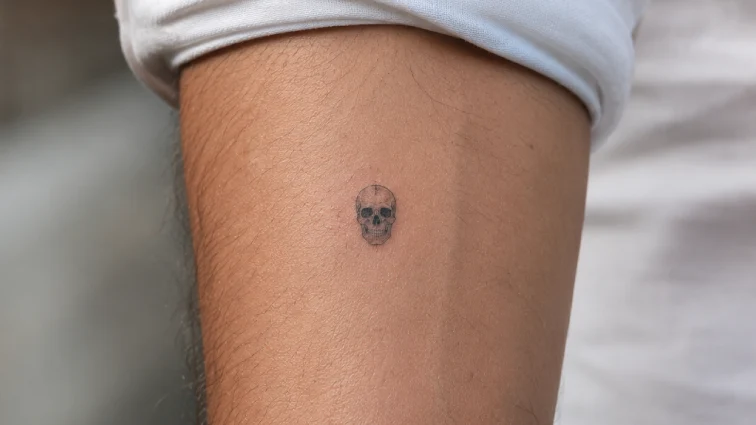
What it is: A tiny, hyper-detailed skull no larger than a coin, placed on the hand, finger, or behind the ear.
Why men are getting it: The skull is the oldest symbol of human mortality. Memento mori, remember that you will die. Far from being morbid, men who choose skull tattoos often report that the reminder sharpens how they live. If you are aware that time is limited, you stop wasting it.
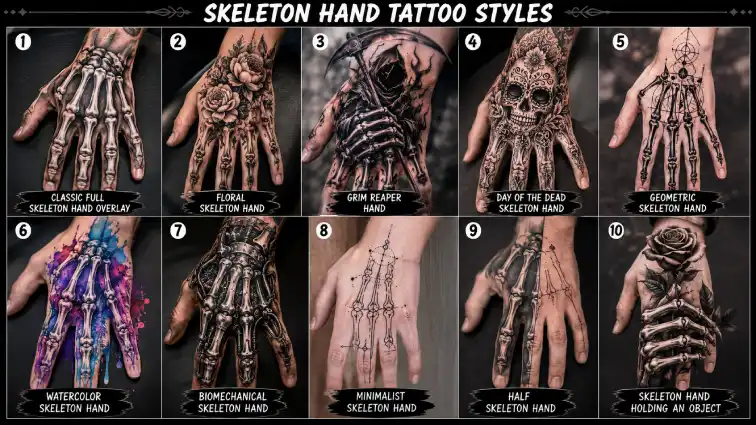
Micro skull work in 2026 is technically remarkable. Artists who specialize in this style can fit full anatomical detail, orbital ridges, cheekbones, nasal cavity, teeth, into a design the size of your thumbnail. If you are drawn to darker imagery at a small scale, exploring skeleton hand tattoo designs alongside micro skull work can help you build a cohesive hand or finger theme that feels intentional rather than random.
Best placement: Back of the hand or index finger for maximum visual impact, though fingers fade fast. Behind the ear for something more subtle that still hits hard when people notice it.
Style to ask for: Single needle micro realism. This is specialized work. Do not book with a generalist artist for this design, find someone who specifically lists micro or miniature tattooing in their specialty.Important note: Finger and hand tattoos typically require touch-ups within two years due to constant skin movement and sun exposure. Factor that into your long-term cost.
Estimated cost: $100 to $200
10. Heartbeat Line (EKG)
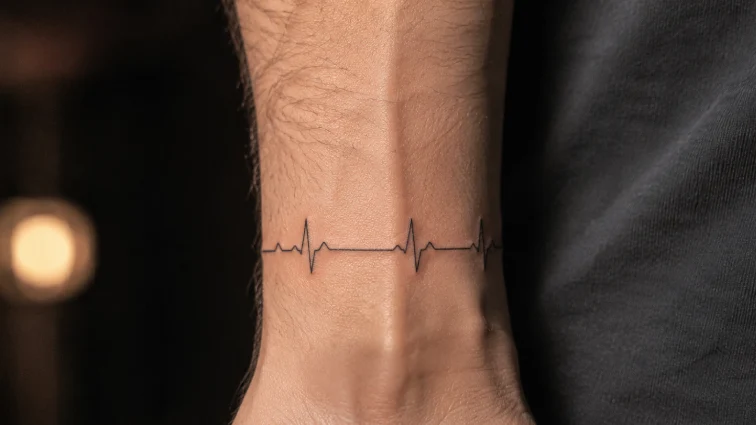
What it is: The visual representation of a heartbeat as it would appear on an electrocardiogram, a flat line that rises into a sharp peak and returns to rest.
Why men are getting it: Few tattoos carry as much emotional directness as this one. It literally says: I am alive, and that matters. Men most often get EKG tattoos in memory of someone they have lost, using the placement as a way to carry that person’s heartbeat with them. Others get it as a reminder to stay present, to keep moving even when the line feels flat.
The addition of a name, date, or small symbol at the peak of the line personalizes it into something completely unique.
Best placement: Inner wrist where you can feel your own pulse, forearm, or collarbone.
Style to ask for: Clean single-weight fine line. The EKG line should be smooth and confident, a wavering line undercuts the entire symbolism.
Estimated cost: $100 to $180
11. Sword
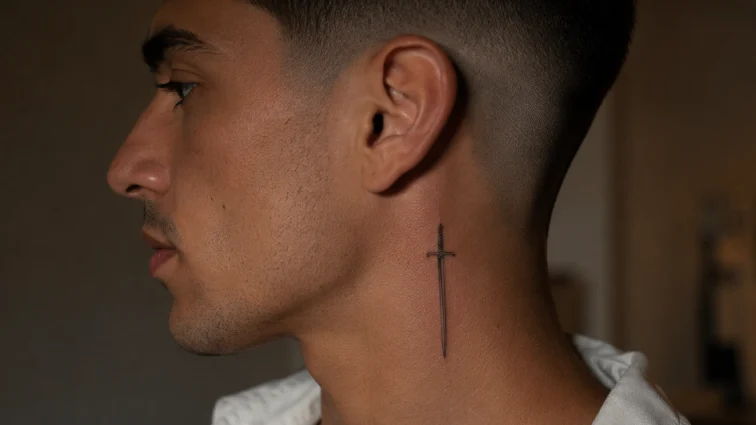
What it is: A minimalist sword, rendered vertically or diagonally with clean fine line work.
Why men are getting it: The sword is one of the most universal symbols of honor, courage, and the willingness to fight for something you believe in. In a modern context, it represents the internal battles men quietly wage, against self-doubt, against circumstances, against the pull to give up. A sword tattoo says: I have something worth fighting for.
Best placement: Forearm running lengthwise is the most striking option. A small sword along the index finger is bold but fades quickly. The back of the calf works well for men who prefer less visible placement.
Style to ask for: Fine line with a slightly heavier weight on the blade’s center ridge to give it a sense of three-dimensional form. Tiny runes or initials etched along the blade are a beautiful personal detail.
Estimated cost: $100 to $200
12. Sun and Moon
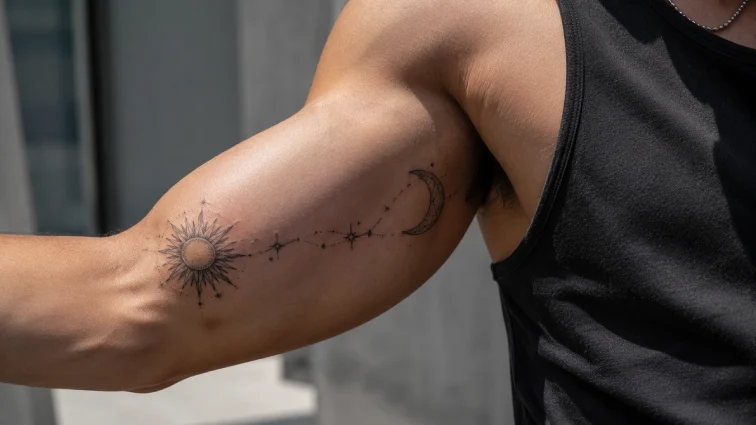
What it is: The sun and moon placed side by side, overlapping, or in a yin-yang inspired arrangement, representing opposing forces in balance.
Why men are getting it: Every man contains contradictions. Strength and vulnerability. Logic and emotion. Public confidence and private doubt. The sun and moon together say: I contain both, and I am not at war with myself. That is a genuinely mature thing to put on your body.
Best placement: Inner wrist, sternum, or upper chest. The sternum placement has become a strong trend for this design in 2026, sitting centered on the chest as a symbol of inner balance.
Style to ask for: Fine line with deliberate use of negative space. The sun can be represented with radiating lines and the moon with a crescent, and the contrast between the two in a small space is visually compelling. Avoid heavy shading at small scale, it muddies the contrast between the two symbols.
Estimated cost: $120 to $200
13. Eye of Horus
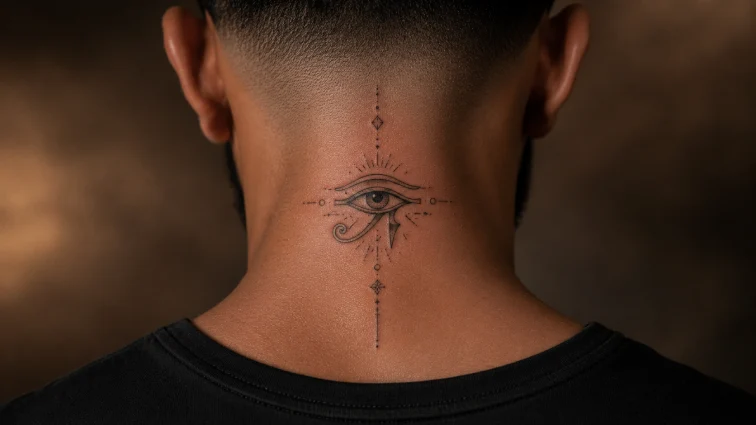
What it is: The stylized eye symbol from ancient Egyptian mythology, representing protection, perception, and royal power.
Why men are getting it: The Eye of Horus has experienced a genuine cultural revival in 2026, partly driven by growing interest in ancient symbolism and partly because modern fine line tattooing allows for the intricate details of the symbol, the inner eye, the tear marking, the brow, to be rendered beautifully at a small scale.
Men choose this symbol for protection, spiritual awareness, or simply as a connection to one of humanity’s oldest visual traditions.
Cultural note: The Eye of Horus is a sacred symbol deeply rooted in ancient Egyptian culture. This does not mean it is off-limits, but it means you should understand what you are putting on your body before you commit. Choosing it because it looks cool is fine. Choosing it because its meaning genuinely resonates with you is better.
Best placement: Inner wrist, back of the hand, or behind the ear.
Style to ask for: Fine line with micro detail on the inner eye markings. A skilled artist can fit extraordinary detail into this symbol even at thumbnail size.
Estimated cost: $120 to $220
14. Small Lion Head
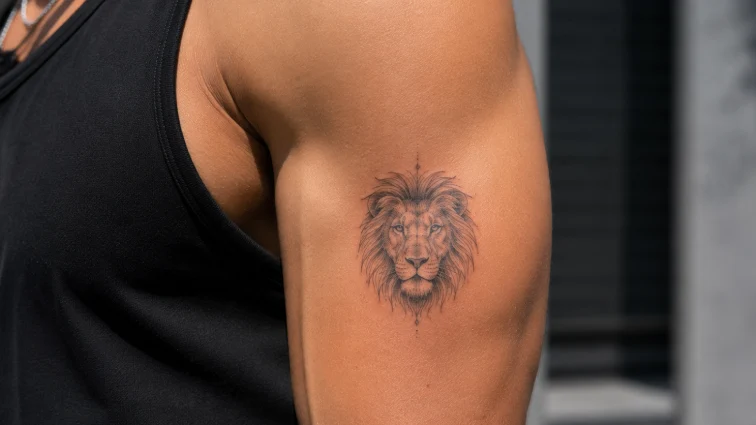
What it is: A lion’s face, forward-facing or at a three-quarter angle, in fine line, geometric, or stipple shading style.
Why men are getting it: The lion is the oldest symbol of masculine power in human history. Kings, warriors, and leaders have used lion imagery across every major civilization. But what makes a small lion tattoo resonate in 2026 is not raw power, it is the idea that courage does not have to be loud. A tiny, precise lion rendered with incredible detail is a quiet statement that lands harder than you would expect.
Best placement: Upper chest, outer forearm, or calf. The chest placement has real symbolic power, the lion sits over the heart, which is exactly where courage lives.
Style to ask for: Fine line with controlled stipple shading to build the mane’s texture. The eyes of a lion tattoo are everything, they need to feel alive and intentional. Review your artist’s portfolio specifically for animal face work.
Estimated cost: $150 to $300
15. Wave
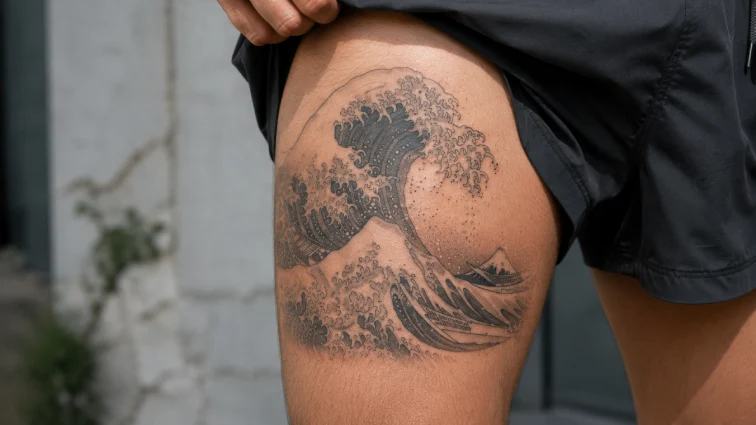
What it is: A single ocean wave, typically rendered in a Japanese-inspired style or as a clean, minimal fine line curve.
Why men are getting it: The ocean is the original symbol of the uncontrollable. Waves do not ask for your permission. They come regardless of whether you are ready, and your only real choice is how you meet them, with panic or with the kind of calm that comes from having been knocked down before and knowing you will surface again.
For surfers and ocean lovers, this is a natural choice. For everyone else, it is a reminder that life’s chaos is navigable.
Best placement: Inner wrist, ankle, or behind the ear. The behind-the-ear wave is one of the most elegant small tattoo placements on this entire list.
Style to ask for: Clean fine line with a Japanese wave influence, a slightly stylized curl at the crest, with a few tiny dots around the break to suggest sea spray. This is more dynamic than a simple curved line and still reads beautifully at a small scale.
Estimated cost: $100 to $180
16. Constellation
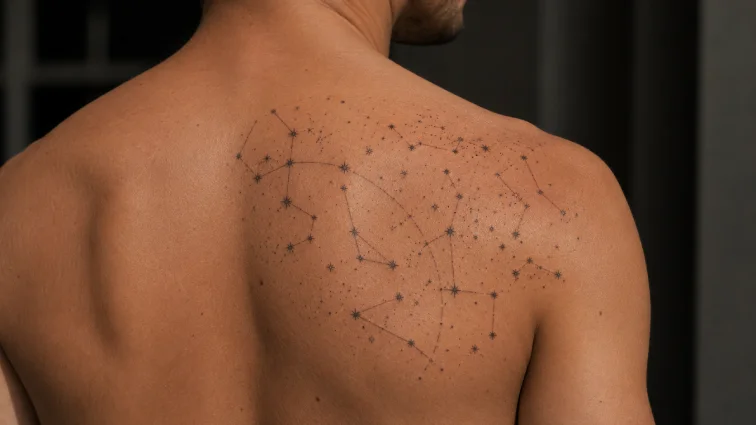
What it is: A personal or meaningful constellation rendered as small dots connected by thin lines, exactly as it appears in star charts.
Why men are getting it: There is something deeply grounding about carrying a piece of the night sky on your skin. Constellation tattoos are almost always personally meaningful, your birth sign, a loved one’s sign, or the stars that were visible on a night that changed your life. They are subtle enough that most people will not immediately recognize what they are looking at, which is part of their quiet appeal.
Best placement: Back of the neck, shoulder, or inner wrist. The back of the neck is particularly beautiful for constellation work, it feels like the stars are sitting just above the horizon of your body.
Style to ask for: Small solid dots with very fine connecting lines. The dots should be consistent in size. Ask your artist how they handle dot work specifically, because uneven dots are the most common technical flaw in constellation tattoos.
Estimated cost: $80 to $150
17. Phoenix Feather
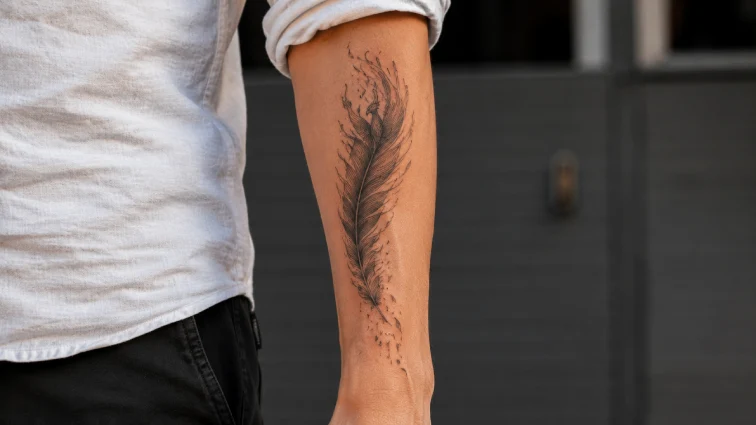
What it is: A single elongated feather from the legendary phoenix, a bird that burns and is reborn from its own ashes.
Why men are getting it: A full phoenix tattoo is a significant undertaking. A single feather carries the same story in a fraction of the space. The phoenix feather is specifically for men who have been through something, genuinely through it, out the other side, and want that chapter marked without dwelling on it. It is a scar you chose to put on your own terms.
Best placement: Forearm running from wrist toward the elbow, or along the ribcage where the feather’s natural length can be honored. The ribcage placement is more private and more painful, but for something this personal, the combination often feels appropriate.
Style to ask for: Fine line with subtle gradient shading, warm at the quill, fading to cool at the barbs. A whisper of color, a touch of amber or gold at the base, can make this design exceptional without turning it into a color piece.
Estimated cost: $150 to $280
18. Small Dragon
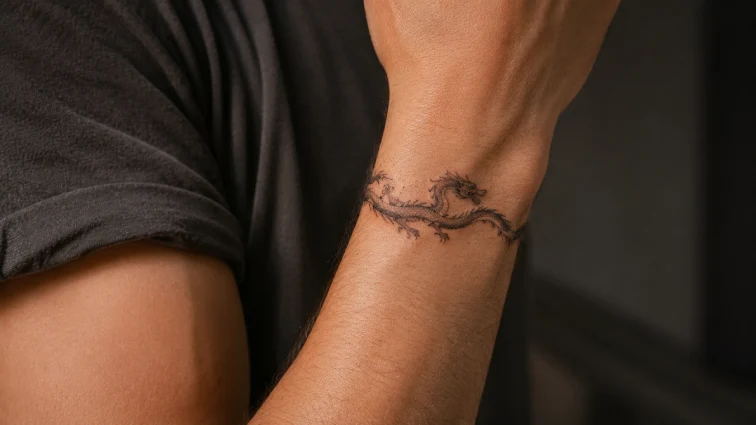
What it is: A lean, coiling dragon, typically wrapping around the wrist or forearm, rendered in fine line with minimal shading.
Why men are getting it: The dragon is arguably the most cross-cultural tattoo symbol in existence. In East Asian traditions, the dragon represents wisdom, prosperity, and natural powe, a force that protects rather than destroys. In Western mythology, it is the ultimate test of courage. Men drawn to dragon tattoos in 2026 are typically pulling from the Eastern interpretation: power that serves a purpose, strength that is disciplined rather than chaotic.
Best placement: Wrist wrap is the most popular option, with the dragon’s tail beginning at the inner wrist and the head reaching toward the top of the hand. Forearm works beautifully for a slightly longer, more detailed design.
Style to ask for: Fine line with a lean, serpentine body, avoid designs that are too stocky or cartoon-like at small scale. A minimal wash of red or gold color at the dragon’s scales or eyes can elevate the design dramatically without turning it into a full color tattoo.
Estimated cost: $150 to $300
19. Semicolon
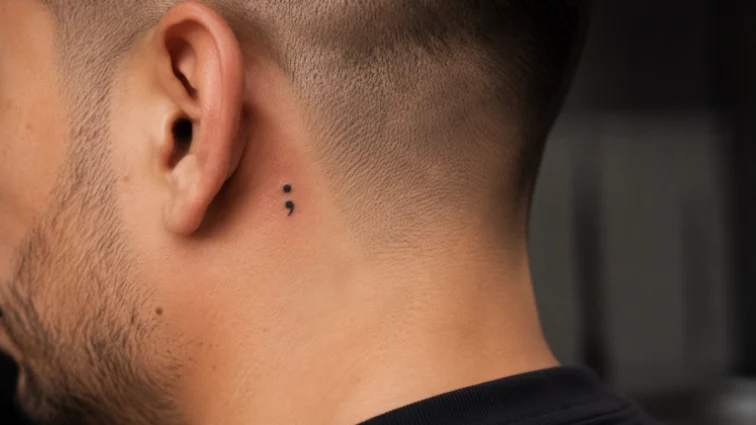
What it is: A punctuation mark, the semicolon, placed typically on the wrist or behind the ear.
Why men are getting it: In writing, a semicolon is used when a sentence could end but the author chooses to continue. As a tattoo, it was adopted by the mental health awareness community as a symbol for the choice to keep going when life feels like it could stop. It represents survival, continuation, and the quiet courage it takes to stay.
If you have fought your way through depression, anxiety, suicidal ideation, or simply a period of life that nearly broke you and did not, this tattoo belongs to that story. It is the smallest design on this list, and the most powerful.
Best placement: Inner wrist, where you will see it when you need it.
Style to ask for: Simple, clean, proportionate. This tattoo is not about artistic flourish. It is about the mark itself.
Estimated cost: $60 to $100
20. Coordinates
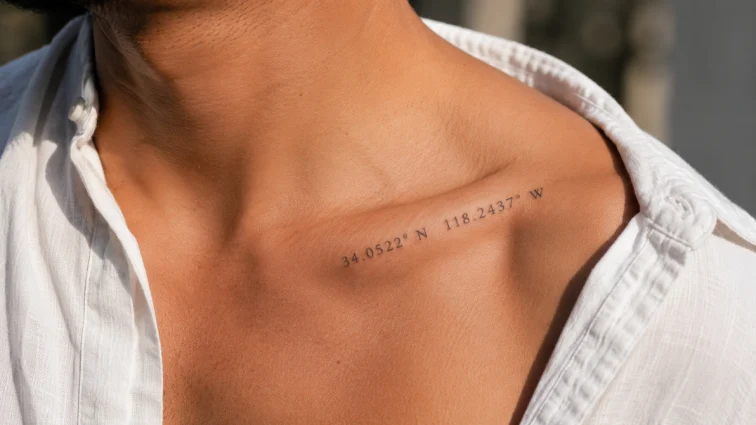
What it is: A set of GPS coordinates in decimal or degrees-minutes-seconds format, marking a specific location on earth.
Why men are getting it: Coordinates tattoos are the most deeply personal design on this list because no two people will ever have the same ones, unless they share the same story. The coordinates of your birthplace, the spot where you met your partner, the mountain you finally summited, the hospital room where someone you loved took their last breath, or the city you escaped to when everything fell apart. The location does not matter. The meaning does.
Best placement: Inner forearm, ribcage, or collarbone. The ribcage placement works well for coordinates tied to grief or private memory. The forearm keeps it visible and present.
Style to ask for: A clean, minimal sans-serif font in a single weight. Avoid decorative typefaces, coordinates are data, and they look best when they look like data. Precise kerning and consistent line weight are everything.
Estimated cost: $80 to $150
Placement Guide: Where to Put a Small Tattoo
| Body Part | Pain Level | Fade Risk | Visibility | Best For |
| Inner Wrist | Low–Medium | Low | High | Daily reminder pieces |
| Forearm | Low | Low | High | Detailed designs |
| Collarbone | Medium | Low | Medium | Horizontal designs |
| Behind Ear | Medium | Low | Low | Private, subtle pieces |
| Upper Chest | Medium | Low | Medium | Meaningful, centered pieces |
| Ankle | Medium | Low | Medium | Nature-themed pieces |
| Back of Neck | Medium–High | Low | Low | Constellation, geometric |
| Finger/Hand | Low | Very High | High | Bold designs (expect touch-ups) |
| Ribcage | High | Low | Low | Private, personal stories |
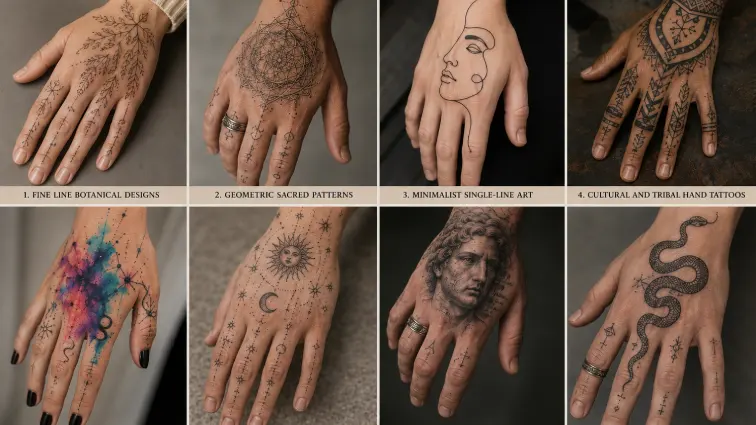
If you are still exploring options for your hands and fingers, browsing hand tattoo ideas beforehand is worth the time. It gives you a realistic sense of scale, style, and how different designs actually sit on that part of the body before you commit.
The honest truth about finger tattoos: They look incredible. They also fade faster than anywhere else on the body due to constant skin movement, washing, and sun exposure. Budget for touch-ups every one to two years if you choose this placement.
How to Find an Artist Who Will Not Ruin Your Tattoo
This is the most important section in this entire post.
Fine line and minimalist tattooing is a specialized skill. An artist who excels at bold traditional tattoos, large-scale realism, or watercolor work is not automatically qualified to do precise fine line small work. These are different techniques requiring different tools, different hand pressure, and different needle configurations.
What to look for in a portfolio:
- Healed photos, not just fresh ones. Fresh tattoos always look sharper than they will after healing. Ask specifically for healed examples.
- Consistent line weight throughout the design. Lines should not wobble, thicken randomly, or break.
- Clean dot work if your design involves dots. Uneven dots are a red flag.
- Previous work at the scale you want. If you want a one-inch design, look for portfolio examples at that size.
Questions to ask at your consultation:
- “Can I see healed examples of similar sized work?”
- “What needle configuration do you use for fine line?”
- “What is your honest opinion on this size and placement combination?”
- “How does this design typically age?”
Red flags that should make you walk away:
- An artist who dismisses your questions about healing and longevity
- No healed photos in the portfolio at all
- Unwillingness to do a consultation before booking
- A quote that seems too cheap for the complexity of the work
Aftercare: What Happens After You Leave the Studio
Most small tattoo failures are not the artist’s fault. They are aftercare failures. Here is exactly what to do.
Days 1 to 3: Keep the tattoo clean and covered with a breathable wrap or the covering your artist applied. Wash gently with unscented soap twice a day. Do not soak in water.
Days 3 to 14: Apply a thin layer of unscented, dye-free lotion, Lubriderm or CeraVe are both excellent options. Do not pick at peeling skin, even when it is desperately tempting. The ink is still settling.
Week 2 onward: Keep the area moisturized and out of direct sun. UV exposure is the number one enemy of fine line tattoos. Once fully healed, use SPF 50 sunscreen on the tattooed area whenever it will be exposed.
One thing most aftercare guides skip: Fine line tattoos are more susceptible to blowout from excessive moisture than bold work. Do not over-moisturize. A thin layer twice a day is plenty. Drowning the tattoo in lotion actually slows the healing and can cause the ink to spread slightly.
Final Thought
The best tattoo you can get is one that still means something to you ten years from now. Not the one that was trending when you got it, not the one you chose because it looked good on someone else’s forearm. Yours. With your story behind it.
Use this list as a starting point, not a shopping cart. Find the design that stops you mid-scroll. Understand why it stops you. Then find an artist who can execute it with the precision it deserves.
That tattoo will be worth every dollar and every minute of healing. The ones chosen carelessly rarely are.