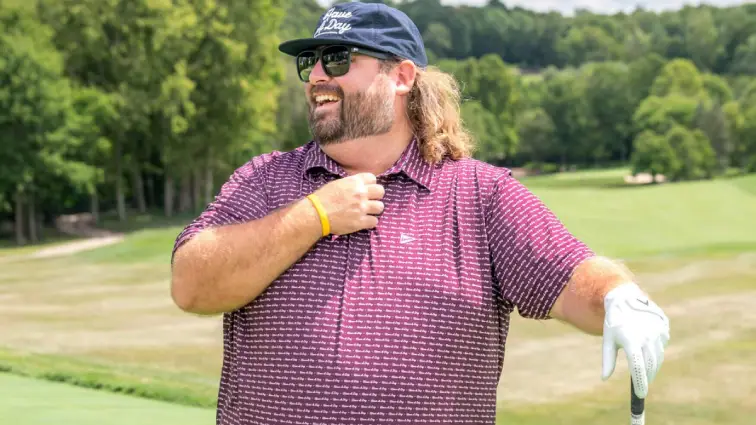
Golf content has a new kind of star, and Fat Perez is one of the biggest. Known for his cigar, his calm tempo, and a swing that’s noticeably better than his “dad bod” image suggests, he’s become one of the most recognizable names in golf YouTube. The question fans keep typing into Google is simple: is he actually good enough to be a pro, and what’s his real handicap?
The short answer: no, he’s not a tour professional, and he’d tell you that himself. But the longer answer — who he is, how good he really is, and how he ended up here — is a lot more interesting than a one-line fact-check.
Fat Perez Quick Facts
| Fact | Details |
| Full Name | Nick Stubbe |
| Popular Name | Fat Perez |
| Age | 47 (born October 1, 1978) |
| Birthplace | Richmond, Virginia, United States |
| Nationality | American |
| Known For | Golf personality, member of Bob Does Sports |
| Golf Status | Highly skilled amateur, not a tour professional |
| Handicap (Estimated) | Plus handicap, with figures cited between scratch and +1.6 |
| Education | History at Hampden-Sydney College; B.S. in Accounting, Virginia Commonwealth University |
| Previous Career | Fraud detection at Capital One; property accountant and asset manager, Commonwealth Commercial Partners |
| Playing Style | Smooth swing, calm tempo, strong short game |
| Wife | Anne Cole Stubbe |
| Net Worth | Estimated in the low millions, primarily from BDS revenue, sponsorships, and merchandise |
Who Is Fat Perez, Really?
Before the cigar and the catchphrases, Fat Perez was Nick Stubbe, an accountant from the Richmond, Virginia area. Golf wasn’t a side interest he picked up for content — it’s genuinely in his family. His golf roots run back generations, and as a kid he spent his summers at what’s now called Lakeside Park Club, where he learned under longtime head professional Tom Barry.
He’s said he’s had a club in his hands since he could stand, and that’s not an exaggeration for the camera — it’s the actual reason he can play at the level he does. He took golf seriously enough to play it competitively in high school and then at the college level, spending two years on the team at Division III Hampden-Sydney College with real hopes of going further.
The thing that ended that dream wasn’t a lack of skill — it was distance. He stopped growing, and the gap between his length off the tee and his more physically gifted teammates’ became too wide to close. So he did what most golfers who don’t turn pro eventually do: he refocused on life, finished a degree in accounting at Virginia Commonwealth University, and went to work in finance, eventually landing roles in fraud detection at Capital One and later as a property accountant and asset manager.
The nickname has a real origin story too. While playing at Hermitage Country Club, a fellow player joked that he looked like PGA Tour pro Pat Perez — just heavier. “Fat Perez” stuck, even though Stubbe reportedly hated it at first.
How an Accountant Became a Golf YouTube Star
The pivot from cubicle to camera happened almost by accident, and it happened because of the pandemic. With offices shut down and little to do, Stubbe joined a Patreon Zoom happy hour hosted by comedian Robby Berger (known online as Bobby Fairways) and his collaborator Joseph Demare (Joey Coldcuts) — the founders of Bob Does Sports. He showed up using his old nickname, and his humor and golf knowledge made enough of an impression that he kept getting invited back.
What started as a recurring guest appearance became a real job. By July 2022, Stubbe had left accounting behind entirely to join Bob Does Sports full-time — a decision he made just a year into his marriage, with his wife’s support but real financial risk attached to it. It paid off. Bob Does Sports grew into one of the most-watched channels in golf, and by 2024 only a handful of creators in the entire golf YouTube space — names like Bryson DeChambeau, Good Good, and Rick Shiels — were pulling in more annual views.
So, Is He a Professional Golfer?
No — and this isn’t really in dispute. Being a tour professional means holding official status on a circuit like the PGA Tour or DP World Tour and earning your living through tournament competition. Stubbe has never held that status, and his livelihood comes from content creation, sponsorships, and his role at Bob Does Sports, not from competing in sanctioned professional events.
What he is, instead, is something golf didn’t really have a category for a decade ago: a serious amateur player whose skill is good enough to hold his own with actual professionals on camera, in a format built around entertainment rather than competition.
That distinction matters more in an era where a tour pro like scottie scheffler can dominate leaderboards on Sunday while a YouTube creator builds an audience just as large simply by being entertaining and clearly skilled at the same time.
What’s His Actual Handicap?
This is the number everyone searches for, and unlike a lot of vague online estimates, there’s real data behind it. Tracking sites that log his on-camera rounds put him at roughly a 0.7 handicap, with a best recorded score of 71 and an average in the low-to-mid 70s. Other profiles of him cite a stronger figure, closer to a +1.6 handicap — meaning he’s typically expected to shoot a stroke or two under par rather than over it.
The range matters more than the exact decimal: anywhere from scratch to plus-1.6 puts him solidly in the same neighborhood as low-single-digit-handicap club champions, which is a level the vast majority of golfers — including plenty of people who’ve played their whole lives — never reach.
Has He Actually Played Against Pros?
Yes, and this is the part most casual fans miss. Stubbe competed in the inaugural Creator Classic at East Lake, the same course that hosts the PGA Tour’s season-ending Tour Championship. He’s also appeared in Bryson DeChambeau’s “Breaking 50” YouTube series, a format where DeChambeau and a partner attempt to shoot a two-man scramble score in the 40s from forward tees — a near-impossible task that requires consistent birdies and the kind of ball-striking that doesn’t show up by accident.
He’s described the experience candidly, saying it almost felt like the Bob Does Sports crew had no business being there, since the platform DeChambeau has built feels like it’s reserved for “real celebrities.” Fair as that self-deprecation is, the access itself is a pretty strong signal of how the golf world actually views his game.
It also explains why crossover athletes like stefon diggs and shannon sharpe have shown up in this same wave of golf content — the line between professional sports and entertainment golf keeps getting thinner, and Stubbe has been right in the middle of that shift.
Playing Style and Strengths
What makes Fat Perez fun to watch isn’t power — it’s how little wasted motion there is in his game. His swing tempo is unhurried, his contact is clean, and he doesn’t try to force distance he doesn’t have. That restraint shows up most in two places:
Ball striking and course management. He plays within himself, avoids unnecessary risk, and keeps the ball in play rather than chasing hero shots. That’s a deliberately conservative approach, and it’s exactly the kind of decision-making that keeps a plus-handicap player’s scores consistent round after round.
Short game and putting. Scratch-level and better golfers are almost always defined by what happens inside 100 yards, not off the tee. His chipping, pitching, and putting hold up under pressure, which is the actual engine behind shooting in the 70s consistently rather than occasionally.
Life Off the Course
Stubbe married Anne Cole Stubbe in 2021, and the two live in Virginia. He keeps his family life largely private and doesn’t lean on it for content, which is a deliberate contrast to how public the rest of his persona is. Financially, his income today comes from a mix of sources rather than one job: his role and equity stake at Bob Does Sports, brand partnerships (including a tequila cocktail line and a flip-flop collaboration), and merchandise sold under his own name.
Estimates of his net worth vary fairly widely by source and year, generally landing somewhere in the low millions — which tracks with someone whose income is spread across content, sponsorship, and ownership stakes rather than a single salary.
What Everyday Golfers Can Learn From Him
You don’t need a plus handicap to take something useful from how Stubbe plays and how he got here.
Distance isn’t the whole game. He never had elite length, and it’s exactly why his college golf dreams stalled. What got him to a plus handicap anyway was accuracy, short game, and decision-making — the parts of golf that are actually trainable at any age, unlike raw power.
Composure scores better than talent alone. Part of what makes him watchable is that he doesn’t unravel after a bad shot. That’s not a personality quirk — it’s a skill, and it’s one of the most repeatable ways to shave strokes off a round, the same low-key, unbothered energy that’s made golf-loving comedic actors like adam sandler so relatable to weekend players who’d rather laugh off a bad hole than sulk through it.
It’s never too late to take the game further. He spent years in an office job, fully outside competitive golf, before any of this happened. His path from accountant to playing at East Lake didn’t follow a traditional pipeline, and that’s exactly why it resonates with golfers who love the game without ever having played it for a living.
Conclusion
Fat Perez isn’t a professional golfer, and he’s never claimed to be one. But dismissing his game because he doesn’t have a tour card misses the point. Few amateurs — including ones who took the sport just as seriously growing up — ever get to a plus handicap, and fewer still get invited to play East Lake or join Bryson DeChambeau in a scramble built for genuine low scores.
His story isn’t really about whether he’s a pro. It’s a reminder that you can build a serious golf game, and a real career around it, without ever needing the title at all.