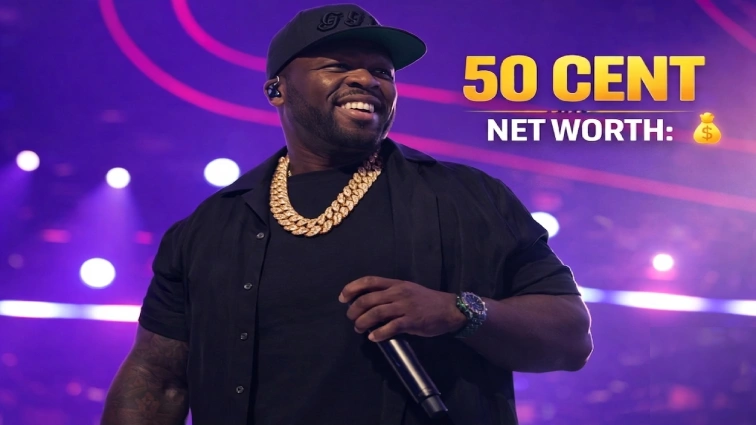
Curtis James Jackson III, better known as 50 Cent, has one of the most remarkable financial stories in entertainment history. He grew up with almost nothing in South Jamaica, Queens, survived a near-fatal shooting, and went on to build a multi-million dollar empire across music, television, and business.
When you look at the 50 Cent net worth story today, the numbers tell only part of the picture. The real story is how he got there, how he nearly lost it all, and how he came back stronger than before. By most estimates, 50 Cent has earned over $300 million throughout his career, and his wealth continues to grow well into 2026.
50 Cent: Quick Facts at a Glance
| Detail | Information |
| Full Name | Curtis James Jackson III |
| Date of Birth | July 6, 1975 |
| Birthplace | South Jamaica, Queens, New York |
| Profession | Rapper, Actor, Producer, Entrepreneur |
| Estimated Net Worth (2026) | $100 Million |
| Total Career Earnings | $300 Million+ |
| Breakthrough Album | Get Rich or Die Tryin’ (2003) |
| Biggest Business Deal | Vitaminwater equity stake ($100M payout) |
| TV Franchise | Power Universe (Starz, 2014 – Present) |
| Starz Production Deal | Up to $150 Million |
| Final Lap Tour Gross | $104.9 Million (2023 – 2024) |
| Bankruptcy Filed | July 2015 (Chapter 11) |
| Bankruptcy Resolved | 2016 ($23M repayment plan) |
| Record Label | G-Unit Records |
| Production Company | G-Unit Film and Television |
| Spirits Brand | Sire Spirits (Branson Cognac, Le Chemin du Roi) |
| Studio Investment (2026) | G-Unit Studios, Shreveport, Louisiana ($124M deal) |
| New Projects (2026) | Fightland (Starz), Moses the Black (film), Street Fighter (Balrog), Shreveport Justice |
From Queens to Global Stardom
Curtis Jackson was eight years old when his mother passed away. He was raised by his grandparents in one of New York’s toughest neighborhoods, and by the time he was a teenager, he was selling drugs to survive. Music became his way out, but the road was anything but smooth.
In May 2000, he was shot nine times outside his grandmother’s home in Queens. He survived after spending nearly two weeks in the hospital. That experience, as brutal as it was, became the foundation of his public identity and his music. He channeled everything into his craft, recording mixtapes that slowly rebuilt his reputation in the industry.
When Eminem discovered one of those mixtapes in 2002, everything changed. He flew 50 Cent to Los Angeles, and alongside Dr. Dre, they signed him to a deal with Shady/Aftermath/Interscope. The stage was set for one of the biggest debut albums in hip-hop history. Few people at that time could have predicted just how large the rapper 50 Cent net worth would eventually become, given how recently he had been fighting for his life.
The Album That Started Everything
Get Rich or Die Tryin’ and Its Financial Impact
When “Get Rich or Die Tryin'” dropped in February 2003, it sold close to 900,000 copies in its first week alone. That kind of debut was almost unheard of at the time, and it instantly turned 50 Cent into a household name across the world. The album eventually moved over 12 million copies globally.
The financial ripple from that album was enormous. It triggered a Reebok deal reportedly worth $50 million, launched G-Unit Records, and opened the door to a G-Unit clothing line. A film of the same name followed in 2005, adding another revenue layer to an already impressive debut run. His second album, “The Massacre,” sold over a million copies in its first four days and stayed at number one for six straight weeks.
What made 50 Cent different from most artists of his era was that he was never just thinking about music. He was thinking about ownership, equity, and long-term income. That mindset would soon lead to the single greatest financial decision of his career.
The Vitaminwater Deal That Changed His Life
How a Beverage Investment Made Him Truly Wealthy
In 2004, 50 Cent partnered with Glaceau, the company behind Vitaminwater. Rather than taking a standard endorsement fee, he negotiated an equity stake in the company in exchange for lending his name and image to their “Formula 50” drink. At the time, many people in his circle thought it was a risky move. It turned out to be a genius one.
In 2007, Coca-Cola acquired Glaceau for $4.1 billion. His stake in the company, widely reported to be around 2.5%, resulted in a payout estimated at $100 million after taxes. It is generally believed he made roughly ten times more from that single business deal than he had made from music up to that point.
That deal permanently shifted how the world saw 50 Cent. He was no longer just a rapper who dabbled in business. He was a real entrepreneur who understood equity, risk, and long-term value. Analysts who study 50 cent net worth investments point to the Vitaminwater deal as the clearest example of what separates him from artists who simply endorse products without asking for a stake. He later said that the experience taught him to always ask for ownership rather than just a paycheck, a lesson that shaped every major deal he made afterward.
Building a Television Empire
The Power Franchise and the Starz Deal
As the music industry changed in the late 2000s and early 2010s, many artists from 50 Cent’s generation struggled to stay relevant. He took a different approach. Rather than chasing chart positions, he pivoted aggressively into television.
In 2014, the show “Power” premiered on Starz. It became the network’s most-watched series ever and ran for six seasons before expanding into a full franchise. 50 Cent served as executive producer and helped shape the show’s creative direction from the very beginning. By 2018, he signed an overall deal with Starz that was reportedly worth up to $150 million over time, including a three-series commitment.
The Power universe eventually grew to include four spinoffs: Power Book II: Ghost, Power Book III: Raising Kanan, Power Book IV: Force, and Power Book V: Influence. All of them are produced through his company, G-Unit Film and Television. That franchise alone represents hundreds of millions of dollars in total value, and several of the spinoffs continue into 2026.
In 2023, he also secured a development deal with Fox, further expanding his presence in broadcast television. This move confirmed that his ambitions as a media executive go far beyond a single cable network.
The Bankruptcy That Was Not a Collapse
A Strategic Reset, Not a Financial Disaster
In July 2015, 50 Cent filed for Chapter 11 bankruptcy protection in Connecticut, listing debts of more than $22 million. Headlines around the world treated it as a collapse. The truth was more complicated.
The filing came after two damaging legal judgments. A jury ordered him to pay $5 million in a lawsuit related to a sex tape case, and a separate judgment had already come down for $17.5 million in a trademark dispute involving a headphone company. Together, those obligations would have been financially crippling without some form of restructuring.
Chapter 11 allowed him to continue earning, running his businesses, and negotiating more favorable terms with creditors. The Power franchise kept generating income throughout the entire period. By 2016, he had agreed to a $23 million repayment plan and exited bankruptcy. By 2017, the process was fully behind him.
In hindsight, the bankruptcy was less a sign of failure and more a tool used by a businessman who understood his legal options. His income never truly stopped, and the restructuring allowed him to move forward without crushing debt hanging over every decision.
Other Business Ventures That Built His Portfolio
From Spirits to Real Estate
Beyond music and television, 50 Cent has built a diverse set of business interests that continue to generate income. His spirits portfolio includes Sire Spirits, through which he has promoted cognac brands including Branson Cognac and Le Chemin du Roi Champagne. These ventures reflect a consistent strategy of choosing industries with premium pricing and long-term brand potential.
His real estate activity has also grown significantly. Starting in 2023, he began acquiring properties in downtown Shreveport, Louisiana, through G-Unit Film and Television Louisiana. By some reports, he became the city’s largest private property owner, with roughly 20 properties acquired and plans for an entertainment district that includes nightclubs, event venues, and expanded film production infrastructure.
He also self-financed his Final Lap Tour in 2023 and 2024, a 103-date global celebration of the 20th anniversary of “Get Rich or Die Tryin’.” Looking at 50 cent net worth 2024 figures alongside the tour numbers makes it clear why that year was one of his strongest financially.
The tour grossed over $104 million from more than 1.18 million tickets sold, making it one of the highest-grossing hip-hop tours of all time. By self-financing the operation rather than partnering with a promoter, he kept a far larger share of the profits, with estimates suggesting he netted between $35 million and $40 million from the tour alone.
What Is 50 Cent Worth in 2026?
A Realistic Look at the Numbers
Pinning down an exact figure for any celebrity’s net worth is difficult, since much of the wealth sits in private equity, production deals, and back-end revenue that never gets publicly disclosed. With that said, most credible estimates place 50 cent net worth 2026 at around $100 million in liquid and documented assets.
However, when you factor in the full scope of his career earnings, including the Vitaminwater payout, the Starz deal, touring income, and ongoing production revenue, the total amount he has earned and generated over his lifetime crosses $300 million easily. His Shreveport real estate and entertainment district represent long-term equity that continues to appreciate. With multiple Power spinoffs still in production and his spirits brands expanding internationally, projections for 50 cent net worth 2026 suggest the figure will continue climbing as those long-term deals mature.
The $100 million figure reflects what he currently holds, while the $300 million figure reflects the empire he has built and the total financial output of a career spent treating every opportunity like a business transaction.
Conclusion
50 Cent’s journey from the streets of South Jamaica to a $300 million empire is genuinely inspiring, not because it was easy, but because it required constant reinvention. He survived a shooting that nearly killed him, turned a debut album into a global franchise, made one of the smartest celebrity investments in history, filed for bankruptcy and rebuilt faster than almost anyone expected, and transformed himself into a legitimate television mogul while most of his peers from the same era faded from the spotlight.
His story is a masterclass in treating fame as a starting point rather than a destination. The music gave him a platform. The business sense built the empire. And the resilience to keep going through setbacks is what made it last.