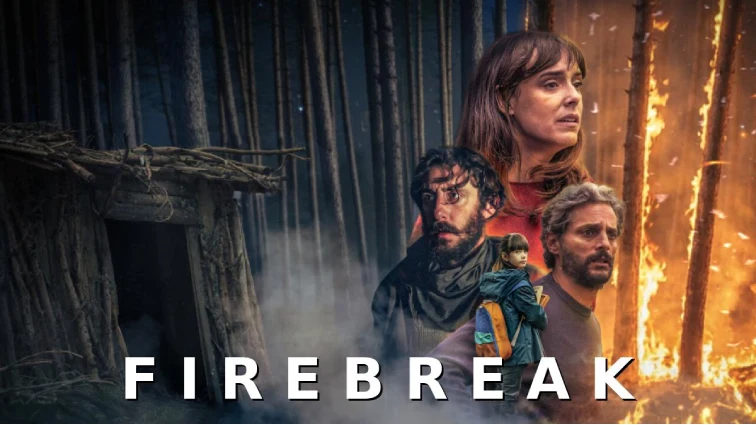
Some movies arrive on a streaming platform quietly, without much fanfare, and then something unexpected happens. Within days, they are all anyone is talking about. That is exactly what happened with the Spanish psychological thriller Firebreak, and for anyone just discovering the firebreak movie 2026 release, the story of its rise is just as gripping as the film itself. Released on Netflix on February 20, 2026.
What looked like a modest international drama about a mother searching for her missing daughter during a wildfire quickly became one of the most-watched films on the entire platform. In less than a week, it had climbed to the number one spot on Netflix worldwide, outperforming major titles and sparking a global conversation about what makes a thriller truly unforgettable.
So how did a relatively low-budget Spanish film, with no major Hollywood names attached, manage to pull off something that big-budget productions often fail to do? The answer lies in a combination of smart storytelling, the right timing, a gifted cast, and a growing audience appetite for international content.
A Story That Hooks You From the First Minute
One of the biggest reasons Firebreak connected with audiences so quickly is its premise. To understand the firebreak movie plot is to immediately grasp why so many viewers could not stop watching. The film centers on Mara, played by Belén Cuesta, a recently widowed mother who returns to her family’s woodland cabin to pack it up for sale. Along for the trip are her young daughter Lide, her brother-in-law Luis and his wife Elena, and their son. What was supposed to be a brief and bittersweet farewell to a place full of memories turns into something far darker.
When Lide disappears into the woods following an argument with her mother, the family is already facing an encroaching wildfire that authorities are struggling to contain. The police launch a search but are soon forced to call it off due to the danger of the fire. Mara refuses to leave. From that point forward, the film never lets you breathe.
Why the Premise Works So Well
The genius of the film’s setup is that it combines two different kinds of fear at the same time. There is the immediate physical danger of the wildfire closing in on the forest, and then there is the psychological terror of not knowing what happened to a child. Both fears feed into each other. As the fire grows closer and time runs out, the emotional stakes keep rising.
Then, the film introduces a third layer. When their neighbor Santiago, the local forest ranger, begins behaving strangely and a piece of Lide’s jewelry turns up in his vehicle, the story shifts into something closer to a paranoid mystery. Suddenly the audience is not just watching a survival story. They are watching a psychological unraveling, unsure of who to trust and what is really going on.
It is worth noting that parents researching the firebreak movie parents guide will find the film contains intense sequences of peril, emotional distress, and themes of grief that may not be suitable for younger children, though there is no graphic violence or explicit content. That combination of disaster film, family drama, and psychological thriller is rare, and when it works, it is incredibly compelling.
The Numbers That Tell the Real Story
The most striking part of Firebreak’s journey is not the story itself but what happened after it landed on Netflix. According to data from FlixPatrol, the film reached the number one position on Netflix globally just three days after its release on February 20, 2026. It topped the charts in 13 countries simultaneously, including Spain, Argentina, Portugal, Poland, Romania, the Netherlands, and Uruguay.
To put that achievement into perspective, Firebreak did not just perform well in its home market of Spain. It outperformed titles with far bigger promotional budgets and household names attached. Most remarkably, it dethroned Ridley Scott’s Prometheus, which had been sitting comfortably at the top of Netflix’s global rankings before Firebreak arrived. In its opening week, the film generated 6.1 million hours of viewing, and by early March, it had accumulated 13.2 million views, making it the top-performing non-English film on the platform during that period.
These are not the numbers of a film that slipped through under the radar. These are the numbers of a genuine streaming phenomenon. The firebreak movie netflix viral trajectory followed a pattern that content analysts recognize well: a strong opening in a core market, followed by algorithmic amplification that carries the title into regions where it had no prior marketing presence at all.
What the Rankings Actually Mean
When a film reaches number one on Netflix globally, it triggers a feedback loop that is hard to stop. Netflix’s algorithm begins promoting the title more aggressively across all regions, which brings in more viewers, which pushes the ranking higher. Word of mouth on social media accelerates the process. People who might never have clicked on a Spanish-language thriller find it at the top of their homepage and give it a chance.
This is precisely what happened with Firebreak. Its early momentum in Spanish-speaking markets created the initial push, and the algorithm did the rest, carrying it across language barriers and into living rooms around the world. The firebreak movie rating on IMDb currently sits at 5.7 out of 10, reflecting the familiar split between general audiences and critics, but the viewing numbers tell a story that a score alone never can.
The Cast That Made It Feel Real
No story works without the people telling it, and Firebreak was fortunate to have an exceptional ensemble. The firebreak netflix cast is headlined by Belén Cuesta, who carries the film almost entirely on her own in many scenes, delivering a performance that is raw, desperate, and completely believable. Her portrayal of Mara is not that of a movie hero who has all the answers. She is a grieving woman making impulsive decisions under impossible pressure, and that vulnerability is what makes her so easy to root for.
There is a particular moment in the film where Mara stands at the edge of the darkening forest, smoke curling in from the tree line, and she simply refuses to move. No dramatic speech, no swelling music. Just stillness and the distant crackle of something burning. It is one of the most quietly devastating images in recent Netflix cinema, and it works entirely because of what Cuesta puts into that silence. You feel the full weight of everything she has already lost and the terror of what she is about to lose again. That single scene does more emotional work than most films manage in an entire runtime.
Familiar Faces, Fresh Roles
What helped draw an international audience right from the start was the familiarity of some of the cast. Both Belén Cuesta and Diana Gómez had appeared in Money Heist, Netflix’s massively successful Spanish series that built a loyal global fanbase over several seasons. When viewers recognized their faces in the Firebreak thumbnail or trailer, there was an instant level of trust and curiosity. These were actors they had already invested in emotionally. For those researching the firebreak movie cast before hitting play, the full ensemble includes Joaquín Furriel, Enric Auquer, Diana Gómez, Candela Martínez, and Mika Arias alongside Cuesta.
Joaquín Furriel brings quiet authority to the role of Luis, the brother-in-law trying to hold everyone together while quietly unraveling himself. And Enric Auquer as Santiago is one of the film’s most fascinating elements. His character is written and performed in a way that keeps the audience permanently unsure about his intentions, and that ambiguity is central to the film’s tension.
The scene inside Santiago’s house is the clearest example of this. The room is dim, the fire is audible outside, and Mara is asking questions that Santiago keeps deflecting in a way that is just slightly off. Nothing he says is an outright lie, but nothing he says fully adds up either. Watching that exchange, you will find yourself replaying his words in your head, trying to work out whether he is hiding something terrible or simply a private man caught in an impossible situation.
The film never lets you settle. Every time you think you have figured him out, a new detail shifts your reading of him completely. Even the child actors, Candela Martínez as Lide and Mika Arias as Dani, deliver performances that feel natural rather than staged, which is harder to achieve than most people realize.
The Director Who Made It All Come Together
David Victori is not a name that most international audiences would have recognized before February 2026. He had directed episodes of the Netflix series Sky Rojo and made a small Spanish thriller called Cross the Line in 2020. Neither of those projects hinted at the kind of global breakout that Firebreak would become.
What Victori brought to the film was a disciplined approach to tension. He understood that the scariest moments in a thriller are often the quiet ones, the lingering shot of a door left open, the sound of the fire in the distance that you cannot see yet, the pause before someone answers a question they should answer immediately. He used the claustrophobia of the forest setting to keep the camera close to the characters, making the outdoor wilderness feel as suffocating as a locked room.
One sequence that captures this perfectly is when the family is trapped in a narrow canyon while searching for Lide, the fire closing in on both sides and the smoke so thick that visibility drops to almost nothing. The camera does not pull back to show the scale of the danger. It stays tight on faces, on hands gripping one another, on eyes scanning the dark. The restraint makes it almost unbearable to watch. You are not a spectator looking at a disaster from a safe distance. You are right there in the smoke with them, and that is entirely a directorial choice.
A Script Built for International Audiences
The screenplay, written by Victori alongside Javier Echániz, Asier Guerricaechebarría, and Jon Iriarte, was crafted to work on multiple levels. On the surface it is a survival story. Underneath, it is about grief, guilt, the speed at which trust collapses under pressure, and the lengths a parent will go to protect a child.
These are universal themes that do not require translation. In nearly every firebreak movie review published after its release, critics acknowledged the strength of this emotional foundation even when they had reservations about certain plot choices.
That universality is a significant reason why the film resonated as powerfully in Argentina and Romania as it did in Spain. The language was different, but the emotional core was something every viewer could recognize.
The Timing That Gave It a Clear Runway
Every film’s success is partly about the story it tells and partly about the moment it arrives. Firebreak was released during a relatively quiet stretch on Netflix, with no major high-profile English-language films competing for the top spot at the same time. That gave it room to climb.
Beyond the release calendar, there is also a broader cultural context to consider. Wildfires have become an increasingly prominent part of the global news cycle in recent years, affecting communities across Europe, North America, and Australia. A film that uses a wildfire as both a physical threat and a metaphor for out-of-control grief and suspicion taps directly into anxieties that audiences are already carrying.
Social media played a big part in this too, with viewers rushing to post their reactions to the firebreak movie ending, driving curiosity among people who had not yet watched it and pulling them in.That kind of resonance is difficult to manufacture. Firebreak arrived at a moment when audiences were primed to feel it.
What the Success of Firebreak Tells Us About Streaming Today
The story of how Firebreak became Netflix’s top thriller of 2026 is about more than one film. It reflects a significant shift in how global audiences consume entertainment. For a long time, the assumption in Hollywood was that international films could find niche audiences but would rarely dominate mainstream charts. The success of Money Heist began to challenge that assumption. Firebreak has reinforced it.
Audiences are no longer reluctant to read subtitles. What they want is a story that moves quickly, characters they can connect with emotionally, and a sense of suspense that keeps them watching past their bedtime. Firebreak delivered all three.
It also showed that a modest production budget is not a barrier to global success when the writing and performances are strong enough. The film was not built around spectacular action sequences or expensive visual effects. It was built around human fear, human grief, and human mistrust, and those are things that cost nothing to portray if you have the right people doing the portraying.
Conclusion
The rise of Firebreak from a quiet Spanish thriller to Netflix’s most-watched film worldwide in 2026 is one of the most instructive success stories in recent streaming history. It is a reminder that great storytelling travels, that audiences everywhere respond to genuine emotion, and that the streaming age has permanently changed what it means for a film to break through. For anyone who has not yet watched it, the numbers alone make a compelling case. For anyone who already has, it is easy to understand why those numbers exist.